
Asteroids Trade Rocks and Dust in Gentle Collisions
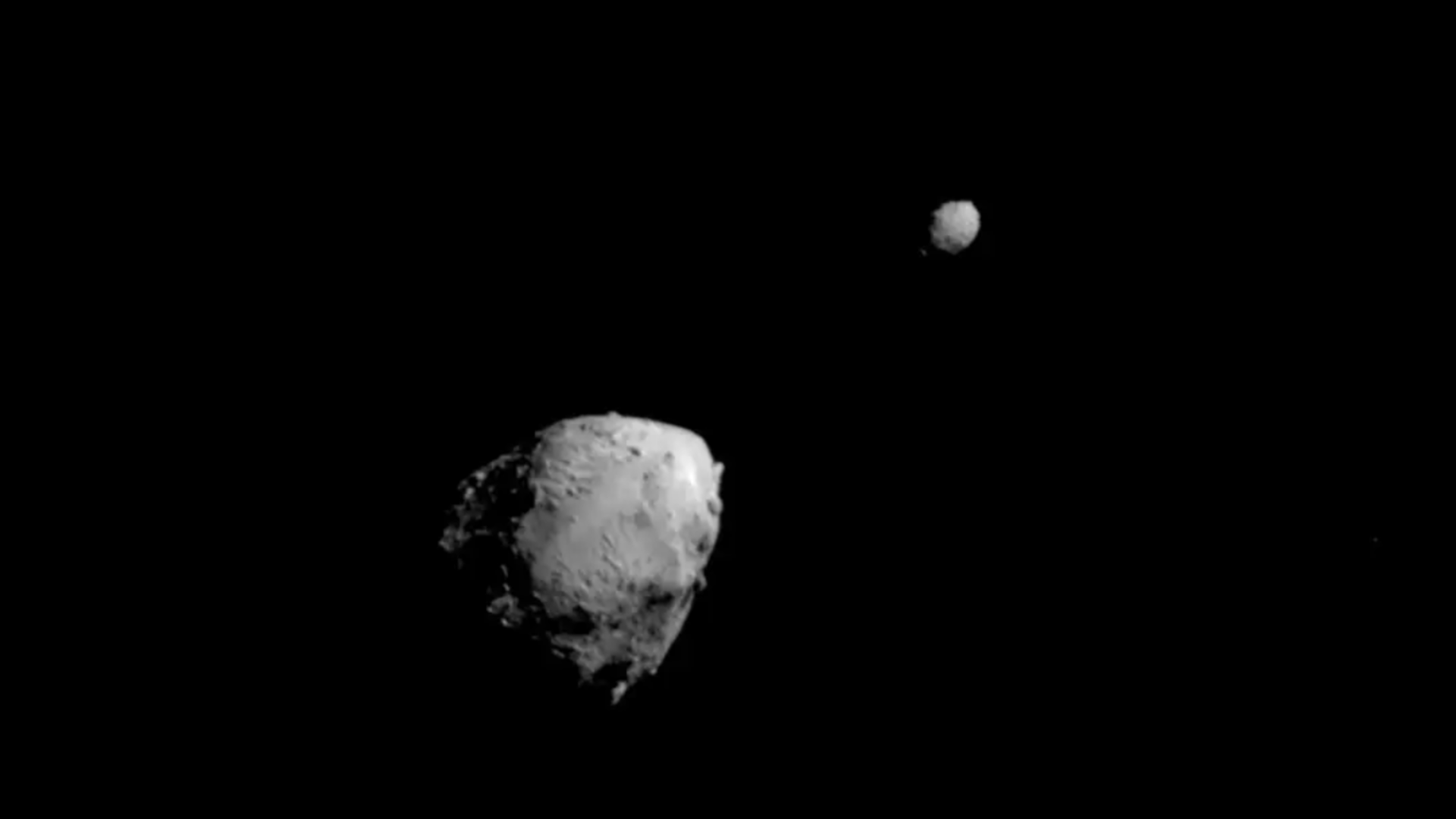
Dynamic Nature of Binary Asteroid Systems
Binary asteroid systems, often thought to be static, are actually quite dynamic. A research team from the University of Maryland has discovered that asteroids with small moons can exchange rocks and dust through slow, gentle collisions. This process continues over millions of years, shaping the surfaces and structures of these orbiting bodies.
These interactions resemble cosmic snowballs, gradually altering the appearance and composition of the asteroids. The DART mission’s imaging provided astronomers with an unprecedented view of these exchanges, highlighting the significant role that small moons play in the evolution of asteroids.
Understanding this process is crucial for predicting asteroid behavior near Earth and gaining insights into the early solar system. Such interactions may have played a key role in distributing materials across space.
First Direct Evidence of Material Exchange
New images captured by NASA’s DART spacecraft have revealed the first direct evidence of rocks and dust moving naturally between asteroids. These images were taken just before DART’s 2022 collision with Dimorphos, showing bright, fan-shaped streaks on the moon's surface. These streaks are indicative of low-velocity impacts.
Initially, researchers questioned whether the streaks were due to camera or processing errors. However, after careful analysis, they confirmed that the streaks were caused by slow-moving material—essentially “cosmic snowballs.” The findings, published in The Planetary Science Journal, offer important insights into the dynamic behavior of binary asteroid systems and could enhance our understanding of how such bodies evolve over millions of years, including those that might pose a threat to Earth.
The study also provided the first visual proof of the YORP effect, where sunlight causes asteroids to spin faster until chunks of material break off, sometimes forming moons. This appears to be the case for Didymos and its moon Dimorphos, as seen in the “cosmic snowball” streaks on Dimorphos’ surface.
Uncovering the Streaks
Identifying these streaks required months of meticulous work. They were initially hidden in DART’s original photos, but UMD researchers Tony Farnham and Juan Rizos developed techniques to remove shadows and lighting effects. Once cleaned, the images revealed the fan-shaped traces left behind by material slowly moving between the two asteroids.
Tracing the Fan-Shaped Streaks
Analyzing the DART mission images presented unique challenges for researchers. Because the spacecraft approached Dimorphos on a nearly straight path, the lighting and perspective changed very little, making it difficult to distinguish real features from visual artifacts. To confirm the streaks were genuine, the team carefully traced them back to a single region near the moon’s edge—well away from the area where sunlight hit directly.
This mapping showed that the fan-shaped marks were not illusions caused by lighting. Instead, they were clear evidence of material moving slowly between the asteroid and its moon, the so-called “cosmic snowballs” that reveal the dynamic nature of binary asteroid systems. Refining their 3D model of Dimorphos made the fan-shaped streaks stand out more clearly, Farnham said, confirming the team was observing real features.
Visual Proof of the YORP Effect
Scientists had previously observed indirect signs that sunlight can spin small asteroids faster and fling material into space, but the UMD team’s models now provide the first direct visual proof. They also identified exactly where material from the larger asteroid, Didymos, landed on Dimorphos. Further calculations by UMD alum Harrison Agrusa showed the rocks left Didymos at about 1 foot per second, demonstrating that these “cosmic snowballs” drift gently through space rather than being blasted away.
Posting Komentar untuk "Asteroids Trade Rocks and Dust in Gentle Collisions"
Please Leave a wise comment, Thank you