
Why Some Battlestar Galactica Tech Feels Outdated
The Vision Behind "Battlestar Galactica"
The reimagined version of "Battlestar Galactica" aimed to present a space opera that felt grounded in reality. Co-creator Ronald D. Moore, inspired by his experiences on "Star Trek," developed the concept of "naturalistic science-fiction." This approach involved using handheld cameras reminiscent of "cinéma vérité" documentaries, and it created a world that closely mirrored the one audiences lived in.
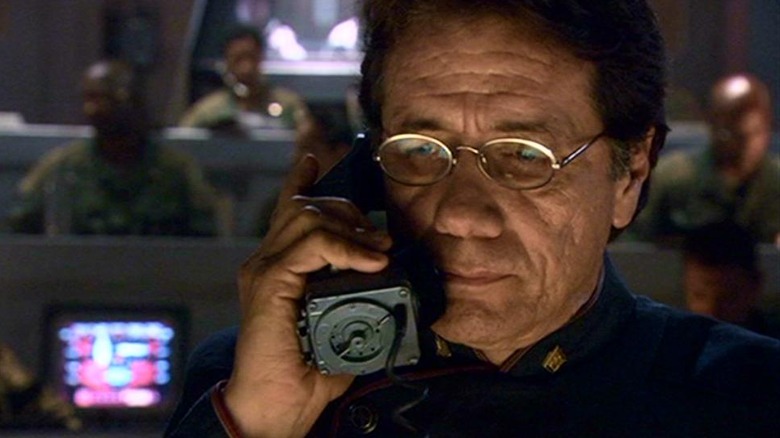
The characters in the series behaved like they were part of a U.S. Navy aircraft carrier. Except for faster-than-light travel, the technology aboard the Battlestar Galactica was comparable to that of a modern navy. Communication systems relied on corded telephones rather than the handheld communicators or viewscreens seen in "Star Trek." The Colonial Navy still used paper documents instead of tablets. Even the more advanced Battlestar Pegasus had CRT computer monitors from the 1990s.
This deliberate choice to use older technology wasn't just for aesthetic purposes. It was rooted in the show's premise: the people of the 12 Colonies of Man created robots called Cylons who eventually rebelled and waged war against their creators. As Edward James Olmos noted, "Battlestar Galactica" and "Blade Runner" share a universe.
A Civilization That Abandoned Digital Innovation
According to Moore’s series bible, the 12 Colonies abandoned innovations like computer networking and microprocessors because Cylons could hack into them. This decision meant that the Colonials lost access to digital luxuries such as the internet and video games. In contrast, the Cylons evolved to take on human form, highlighting the technological gap between the two sides.
The lack of computer networking in "Galactica" wasn't just a narrative device; it was directly tied to the series' focus on tactility. Moore emphasized that while the ship could travel faster than light, officers had to go through long verbal checklists, with enlisted personnel flipping switches and pressing buttons to make it happen. Human brains were needed to crunch numbers, organize data, and solve complex problems.
The Prequel Series "Caprica"
The prequel series "Caprica," which did not achieve the same success as "Battlestar Galactica," showed that Colonial technology was more advanced 58 years before the events of "Galactica." Scientists had also made breakthroughs in virtual reality as a consumer product. However, the series failed to live up to expectations, and co-creator David Eick has since reflected on why that might have happened.
In the "Battlestar" pilot mini-series, a key scene features Commander William Adama (Edward James Olmos) and future-President Laura Roslin (Mary McDonnell) debating whether to install a networked computer on Galactica. Adama, a veteran of the Cylon war, strongly opposed the idea. The show ultimately proves him right when the Colonial fleet starts reintegrating computer networking systems designed by Dr. Gaius Baltar (James Callis). However, Baltar's lover, a Cylon infiltrator (Tricia Helfer), adds a backdoor to the system, allowing the Cylons to launch a nuclear attack on the 12 Colonies. Galactica survives because it didn't have Baltar's software installed.
A Warning Against Uncontrolled Technology
Moore wrote in the "Galactica" bible that Cylons should be seen as an extension of current ideas about how computer technology could be exploited and used for artificial intelligence. While real-life AI is not yet at Cylon-level, "Battlestar Galactica" serves as a powerful warning against creating technology that cannot be controlled.

Posting Komentar untuk "Why Some Battlestar Galactica Tech Feels Outdated"
Please Leave a wise comment, Thank you