
Sunglint Reveals Ocean's Mirror-Like Appearance from Space
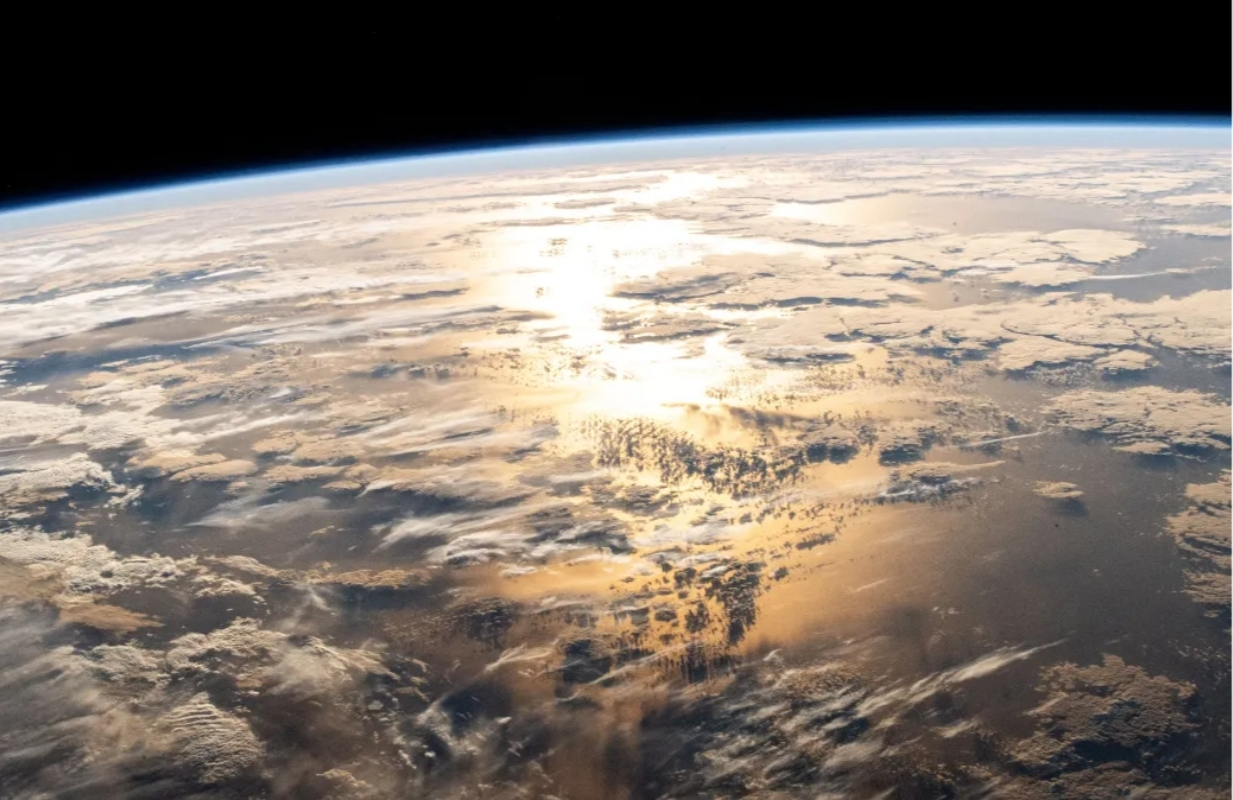
Sunglint on Atlantic Ocean (Image via NASA)
Sunlight reflecting off the ocean can create mirror-like images visible from space, a phenomenon known as sunglint. This occurs when sunlight reflects from the water surface at the same angle that a satellite sensor or astronaut views it, producing a specular reflection back toward the observer. The International Space Station recorded such reflections over the Atlantic Ocean on March 5, 2025, showing how ocean surfaces can appear like mirrors.
While sunglint creates visually bright patterns, it can interfere with remote sensing of ocean properties such as color and phytoplankton levels, requiring specialized processing methods to separate the reflection from water-leaving signals.
How Sunlight Reflects Off the Ocean Surface
The mechanism behind sunglint is based on the orientation of the water surface allowing sunlight to reflect directly toward a sensor. The radiance measured by the sensor includes contributions from atmospheric scattering, sky reflection, whitecaps, sun glint, and water-leaving light. According to MDPI, the sun glint component can dominate the radiance, making it challenging to retrieve information such as chlorophyll concentration, benthic features, or bathymetry.
In practice, separating the sun glint from other radiance components requires high measurement sensitivity and algorithmic correction based on the sun’s position, sensor viewing angle, and sea surface conditions. The amount of sun glint can be predicted using the laws of reflection, the solar and sensor position, and a statistical model of the sea surface, as described in MDPI.
Challenges for Ocean Color Observations
Sunglint complicates measurements of ocean color, which is the spectral signature of water resulting from interactions of sunlight with water and its constituents. NASA’s Ocean Color Web collects and distributes data from satellite instruments, airborne sensors, and shipborne campaigns to provide information on phytoplankton, dissolved organic matter, and other water components.
Sunglint can obscure these signals, making standard ocean color processing less reliable. Researchers have developed methods to screen or correct glint-contaminated imagery to ensure accuracy, particularly for high-resolution coastal observations where near-infrared signals can indicate glint intensity.
For open ocean imagery with resolutions of 100–1,000 meters, statistical models of the sea surface and wind conditions are used to calculate the probability of glint occurrence, according to MDPI.
Applications of Sunglint Detection
Despite its interference with water property measurements, sunglint can assist in detecting oil on the water surface. According to NASA, oil layers smooth the water surface, enhancing the reflection of sunlight and making oil spills or natural seeps more detectable from space. Various correction techniques exist for different sensor resolutions.
Open ocean imaging often uses statistical models of sea surface orientation and wind data, while high-resolution coastal or shallow water mapping uses near-infrared measurements to estimate and remove the glint radiance component. Methods that estimate glint from near-infrared signals assume that water-leaving radiance in that spectrum is negligible, improving the retrieval of coastal and shallow water properties as noted in MDPI.
Instruments Monitoring Ocean Color
NASA and partner agencies have deployed multiple instruments to observe ocean color, including the Ocean Color Instrument aboard the PACE mission, VIIRS on NOAA satellites, and OLCI on Sentinel-3B. Historical instruments such as SeaWiFS, MODIS, and HICO have contributed long-term datasets for global and regional ocean studies.
Sunglint correction methods are integrated into data processing for these instruments to improve the retrieval of water column properties and coastal habitat information, allowing consistent monitoring despite the presence of mirror-like reflections. Data from these instruments are archived and distributed through NASA’s Ocean Biology DAAC as part of the Ocean Color Web, according to NASA.
Posting Komentar untuk "Sunglint Reveals Ocean's Mirror-Like Appearance from Space"
Please Leave a wise comment, Thank you