
Could Dyson Spheres Thrive Around Red Dwarfs? New Study Reveals Clues
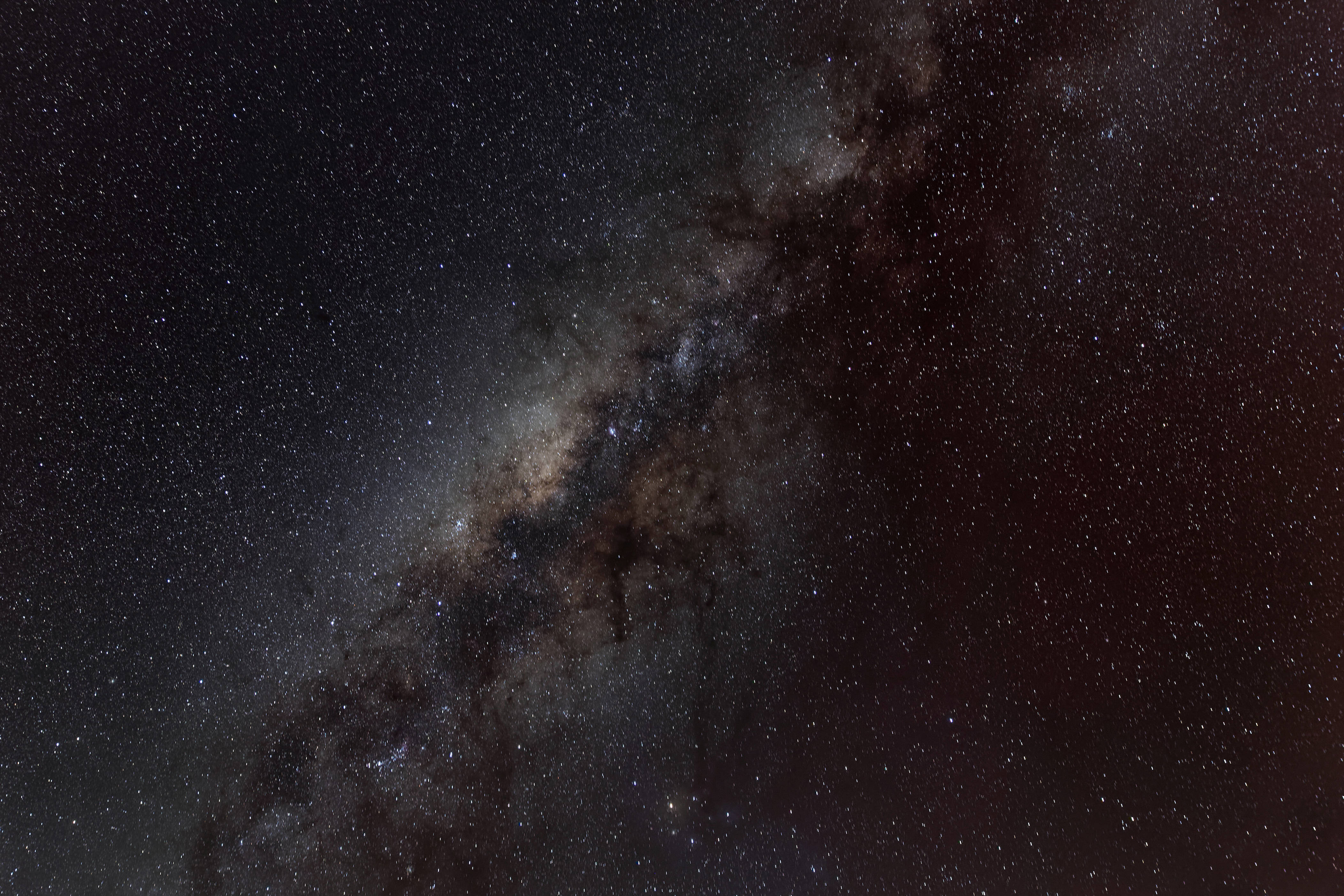 SAN PEDRO DE ATACAMA, CHILE - AUGUST 26: The Milky Way appears over the Valle de la Luna in the Atacama Desert, considered the driest place on earth on August 26, 2022 near San Pedro de Atacama, Chile. The extreme aridity makes the Atacama Desert one of the clearest places on earth to view the night sky. Much of the region receives less than half an inch of rainfall per year, and some areas none at all for hundreds of years. Located in Chile's northern third between two mountain ranges, the Atacama is possibly the oldest desert on earth, experiencing extreme aridity for at least 3 million years. The area is home to the Atacama Large Millimeter/submillimeter Array (ALMA) telescope. The Valley of the Moon is so called because of its lunar and even Mars-like appearance.
Ever since physicist Freeman Dyson proposed the concept in 1960, scientists have considered the possibility of highly advanced civilizations building megastructures to capture the full energy output of their host stars, now referred to as Dyson spheres.
A recent paper by Amirnezam Amiri of the University of Arkansas, available on arXiv and soon to be published in Universe, examines the types of stars most likely to host such structures.
The study identifies red dwarf stars as a prime candidate due to their abundance and long lifespans, indicating that Dyson swarms could exist around these stars at distances between 0.05 to 0.3 astronomical units from the stellar surface, according to Universe Today.
Investigating the Possibility of Dyson Spheres Around Red Dwarf Stars
Dyson Sphere Construction Around Red Dwarfs and White Dwarfs
Red dwarf stars are the most common stars in the Milky Way and burn through their nuclear fuel very slowly, making them extremely long-lived. Universe Today reports that a Dyson swarm could be built around red dwarfs at relatively low material cost.
White dwarfs are another potential host, as their small radii, approximately 1% of their original star, allow a Dyson swarm to be constructed a few million kilometers from the surface while radiating energy steadily for billions of years.
Cornell University adds that Dyson spheres around both white dwarfs and M-dwarfs can be analyzed using radiative balance arguments to compute temperature-radius relationships and assess observational signatures.
Observational Signatures and Infrared Detection
A Dyson sphere blocks a star’s natural light and emits the captured energy as heat or infrared radiation. Universe Today notes that this shifts the star’s location to lower temperatures on the Hertzsprung-Russell (H-R) diagram without changing the vertical bolometric luminosity.
A typical red dwarf has a surface temperature of approximately 3,000K, while a Dyson sphere surrounding it could emit at around 50K, creating a region of the diagram where no natural stars exist.
Cornell University confirms that full energy interception by a Dyson sphere produces cooler blackbody emissions for white dwarfs and longer wavelength emissions for M-dwarfs, with total luminosity remaining fixed.
Technosignature Detection and Candidate Identification
Infrared telescopes, including the James Webb Space Telescope and WISE, are capable of monitoring for Dyson spheres. Universe Today reports that Project Hephaistos identified seven potential Dyson sphere candidates among red dwarfs in a catalogue of five million stars, with one eliminated due to alignment with a background supermassive black hole.
Five remaining candidates may warrant further observation. Dyson swarms could exhibit small gaps between solar collectors, producing irregular light curves.
Lack of dust around radiator panels could also serve as a distinguishing spectrographic signature, as silicate emission associated with dust disks would not be present.
Practical Considerations for Future Research
Both Universe Today and Cornell University emphasize that infrared surveys provide practical constraints for future searches. Cornell University shows that astronomers use equilibrium temperatures and fluxes to determine Dyson sphere positions on the H-R diagram and assess their detectability.
Universe Today explains that light curves will change when a swarm contains gaps or different thickness sections, which scientists can use to detect potential megastructures around stars with low luminosity.
The studies grant researchers multiple methods to find red dwarf stars that might have Dyson swarms. Cornell University also states that Dyson sphere radius increase will cause equilibrium temperature to decrease, which researchers can use to develop their observational plans.
Stay tuned for more updates.
Posting Komentar untuk "Could Dyson Spheres Thrive Around Red Dwarfs? New Study Reveals Clues"
Please Leave a wise comment, Thank you