
Why Is Mercury the Only Liquid Metal?
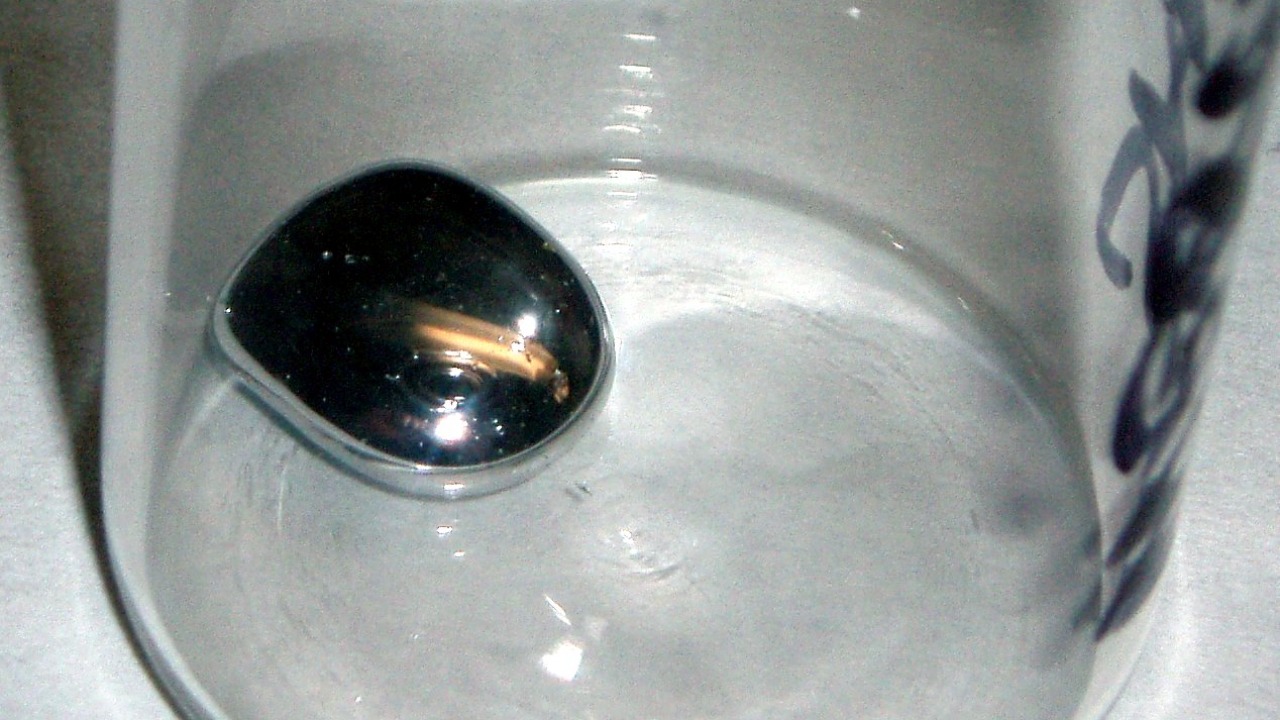
The Unusual Behavior of Mercury
Mercury is a unique element in the periodic table, known for its ability to remain liquid at room temperature. Unlike other metals such as gold, copper, or iron, which solidify at much higher temperatures, mercury freezes at approximately -38.8 degrees Celsius. This characteristic makes it an intriguing subject for scientific study, especially when considering the underlying physics that governs its behavior.
Electrons Moving Near the Speed of Light
At the heart of mercury's unusual properties lies the behavior of its electrons. With 80 protons in its nucleus, mercury has a strong positive charge that pulls its innermost electrons into tight, fast orbits. These electrons move at velocities that are a significant fraction of the speed of light. According to Einstein’s theory of special relativity, this high velocity causes their mass to increase, leading to a contraction of their orbitals closer to the nucleus. This contraction affects the entire electron shell structure, resulting in a tightly bound configuration of the outermost 6s electrons.
This tight binding has a direct impact on mercury's chemical properties. Metallic bonding typically relies on the free sharing of outer electrons among atoms. However, the relativistic effects in mercury stabilize these electrons, making them less likely to form strong bonds with neighboring atoms. As a result, the metallic bond in mercury is extremely weak, preventing it from forming a solid crystal at ordinary temperatures.
Simulations That Turned Off Relativity
To test the hypothesis that relativity plays a crucial role in mercury's liquid state, a team of researchers led by Peter Schwerdtfeger conducted computer simulations. They compared two scenarios: one that included relativistic effects and another where they were turned off. The results were striking. When relativistic effects were considered, the simulations predicted a melting point consistent with mercury's known freezing behavior below zero Celsius. In contrast, when relativity was excluded, the predicted melting temperature rose significantly, suggesting that mercury would behave like a solid metal at room temperature.
These simulations highlighted the importance of relativistic effects in determining mercury's phase behavior. The researchers used advanced electronic-structure methods to account for these effects, reinforcing the conclusion that relativity is a dominant factor in keeping mercury liquid under normal conditions.
A Freezing Point Measured to Six Decimal Places
Mercury's precise phase transition has made it valuable beyond chemistry classrooms. The National Institute of Standards and Technology (NIST) designates mercury’s triple point—the exact temperature and pressure at which solid, liquid, and gas phases coexist—as a reference point in the International Temperature Scale of 1990 (ITS-90). The assigned triple-point temperature is 234.3156 K, serving as a benchmark for precision thermometry worldwide.
Laboratories calibrating thermometers rely on physical artifacts built around this transition. NIST has detailed work on the manufacture and use of mercury triple-point cells, ensuring repeatability and accuracy. These sealed glass cells contain high-purity mercury and are cooled until the metal begins to freeze, producing a stable temperature plateau that serves as a reference standard.
Why Other Heavy Metals Stay Solid
A common question arises: if relativity affects all heavy elements, why is mercury unique? Gold, element 79, also experiences relativistic contraction of its 6s electron, which is why it appears yellow rather than silver. However, gold has one fewer electron in its outer shell, and its d-orbital electrons contribute strongly to metallic bonding. This results in a robust bond network that keeps gold solid until well above 1,000 degrees Celsius.
Mercury, with a filled 6s subshell and a filled 5d subshell, hits a particular electronic sweet spot where relativistic contraction and a closed-shell configuration reinforce each other. This combination leads to the weakest metallic bond of any element, making mercury uniquely liquid at room temperature.
Practical Stakes Beyond the Thermometer
Mercury's liquid state at room temperature has enabled various applications, including barometers, dental amalgams, electrical switches, and fluorescent lighting. Its high density allows atmospheric pressure to be measured with short fluid columns, while its low vapor pressure ensures stable readings. In older thermostats and tilt switches, mercury droplets could roll to close or open circuits, taking advantage of its conductivity and ability to wet metal contacts.
However, mercury's properties also require caution due to its mobility and volatility. Spills can lead to contamination, and chronic exposure to mercury vapor or compounds is hazardous. As a result, many traditional uses of liquid mercury are being phased out or tightly controlled, even as the element remains essential in specialized contexts.
In metrology, mercury's precisely known phase behavior underpins calibration chains that extend from national standards laboratories to industrial temperature sensors. A platinum resistance thermometer or thermocouple used in manufacturing may trace its accuracy back to a carefully characterized mercury triple-point cell. In fundamental physics experiments, the same predictable freezing point helps stabilize sample environments, ensuring accurate measurements. All of this rests on the peculiar fact that, among metals, mercury is uniquely reluctant to solidify. Strip away relativity, and it would behave much like its neighbors, forming a conventional metallic lattice at room temperature. Leave relativity in place, and the inner electrons reshape the atom’s outer shell, weaken its bonds, and keep the element in shimmering, liquid motion. From the equations of special relativity to the glass cells in standards laboratories, the story of mercury’s low freezing point shows how deeply modern physics is woven into the everyday act of measuring temperature.
Posting Komentar untuk "Why Is Mercury the Only Liquid Metal?"
Please Leave a wise comment, Thank you