
Quantum Entanglement Enables Sharper Optical Astronomy
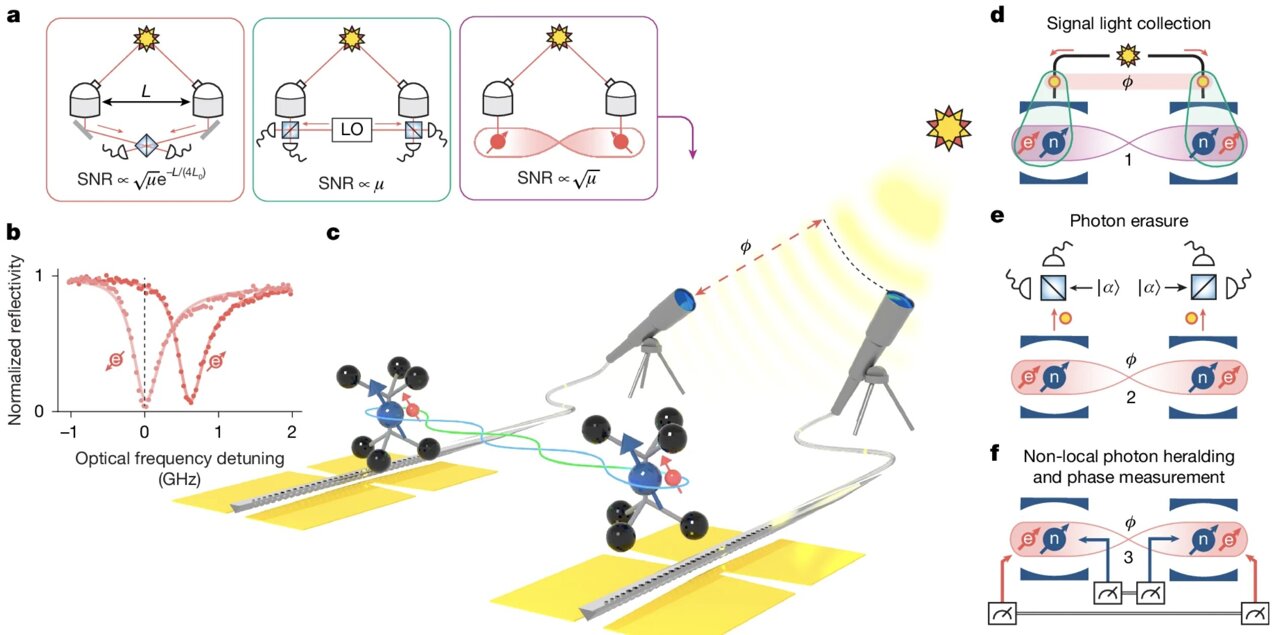
Breakthrough in Quantum Entanglement for Astronomy
A team of researchers in the United States has made a significant breakthrough by demonstrating how quantum entanglement can be used to detect optical signals from astronomical sources at the single-photon level. This development, published in Nature, could potentially pave the way for optical telescopes with unprecedented resolution.
Understanding Interferometry in Astronomy
Interferometry is a technique commonly used in astronomy to produce high-resolution images of distant objects. By combining light collected across networks of spatially separated detectors, this method can achieve resolutions comparable to those of a single telescope with a diameter equivalent to the distance between them. For example, continent-spanning networks like the Event Horizon Telescope were used to create the first direct image of a black hole (Messier 87) in 2019.
However, there are limitations to this approach. In the case of visible or infrared light, signals are detected at the level of individual photons. To recover the phase information needed for interferometry, photons collected by different telescopes must be physically combined and interfered at a central measurement location. The system must also hide any information about which telescope detected each photon.
Challenges in Optical Interferometry
While robust, this approach requires photons to be transported across long distances. As information is quickly lost during this process, optical interferometer networks are typically limited to baselines of around 300 meters, severely restricting their resolution.
Quantum Entanglement as a Solution
In 2012, theorist Daniel Gottesman proposed that the range of optical interferometers could be extended using quantum entanglement. If two or more detectors share an entangled quantum state, an incoming photon can interact with that shared state without needing to be physically transported to a central detector. However, generating and distributing entanglement at the required rates has proven extremely challenging.
Practical Implementation of Quantum Memories
In their study, Stas' team implemented a practical version of this idea using "quantum memories" based on silicon-vacancy centers embedded in diamond nanocavities. These defects in the diamond lattice can store quantum information for relatively long periods by mapping the spin of an electron onto the more stable spin of a nearby atomic nucleus.
By establishing remote entanglement between two of these memories, located at separate stations connected by optical fiber, weak optical signals arriving at the stations could be mapped onto the entangled memories. At the same time, information about which detector the photon had reached was erased. The system also used non-local photon heralding to confirm that a photon had been detected while filtering out background noise.
Achieving Long-Distance Measurements
Together, these steps allowed the researchers to perform a differential phase measurement of weak incoming light between the two stations. In their demonstration, the stations were separated by up to 1.55 km—far longer than the baselines typically used in optical interferometry today.
Future Prospects and Challenges
For now, there is still a long way to go before the technique can be implemented in practical astronomy. Because entanglement can only be generated at a limited rate, Stas' team could collect data at only about 12 millihertz. In addition, misidentified detection events increased noise levels when photon numbers were very small.
Despite these challenges, the demonstration shows that the core components of entanglement-assisted interferometry can work together in practice.
With improvements in entanglement generation, the researchers hope their approach could eventually enable a new class of quantum-enhanced imaging techniques—ultimately leading to new advances in optical astronomy and deep-space communication.
References
P.-J. Stas et al, Entanglement-assisted non-local optical interferometry in a quantum network, Nature (2026). DOI: 10.1038/s41586-026-10171-w
Posting Komentar untuk "Quantum Entanglement Enables Sharper Optical Astronomy"
Please Leave a wise comment, Thank you