
Mesoscale Swimmers: Key to Drug Delivery Robots Inside the Body
Understanding the Mesoscale: A Unique Realm of Physics
In the field of physics, the mesoscale represents a unique domain that exists between the microscopic and macroscopic worlds. It is not only relevant to small organisms like larvae, shrimp, and jellyfish but also involves complex physical principles that differ from those governing other scales. Unlike the macroscopic realm, which is dominated by inertia, or the microscopic one, where viscosity plays a key role, the mesoscale combines both aspects, necessitating a distinct set of physical laws.
A recent study conducted by physicists at Aalto University's Department of Applied Physics has shed light on how organisms navigate this intricate scale. The findings were published in the journal Communications Physics and offer new insights into the mechanics of movement in the mesoscale.
Discovering Efficient Swimming in the Mesoscale
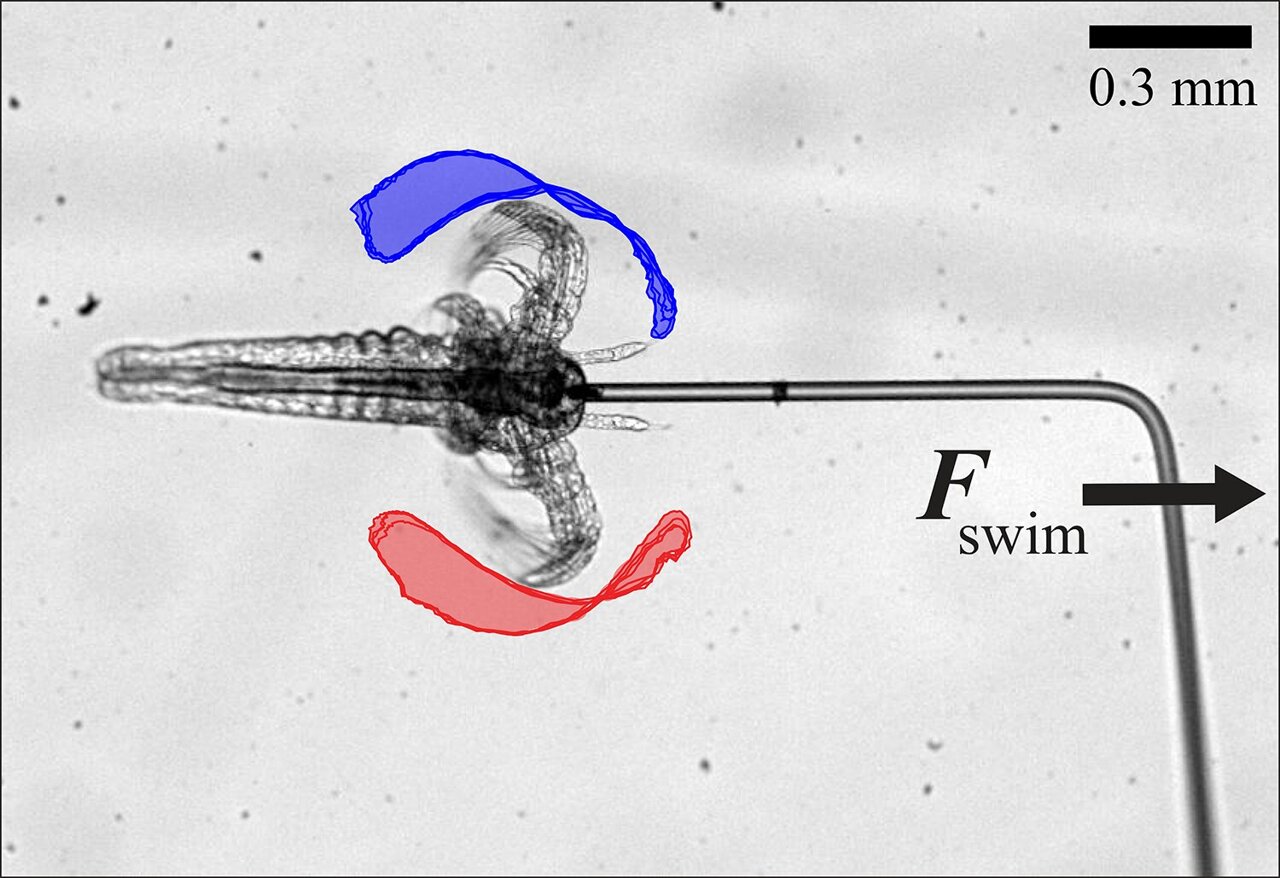
The research, led by Assistant Professor Matilda Backholm, focused on Artemia—organisms that measure between 400 and 1,500 micrometers in length. These creatures exhibit a unique swimming pattern that involves flexing a joint-like part of their antenna, creating a figure-eight motion. This movement introduces an additional degree of freedom, allowing them to break time reversal symmetry, a concept crucial in fluid mechanics.
"Time reversal symmetry means that if you film a movie of swimming bacteria, the bacteria's motion must look different if you play the movie forward or in reverse," Backholm explains. "If this isn't the case, then the swimmer cannot move forward. That's a fundamental requirement at this highly viscous regime in fluid mechanics, but it's not a requirement anymore at the mesoscale."
Despite not being necessary for movement, Artemia appear to break time reversal symmetry, which correlates with more efficient swimming. "We found that if Artemia breaks time reversal symmetry more, they also swim better and have a higher propulsive force," says doctoral researcher Sharadhi Nagaraja. "This is something no one has been able to directly measure for a living organism before."
Advanced Techniques for Measurement
To analyze these movements, the team filmed numerous frames of Artemia's activity and used machine learning to process the data. Handling the organisms required collaboration between physicists and biologists, as well as the use of a specialized micropipette force sensor developed by Backholm. This technique allows for precise measurement of swimming forces without harming the organisms, while simultaneously capturing their movement.
"The micropipette force sensor technique is ideal for directly measuring swimming forces of living meso-organisms, since it doesn't harm the swimmers and allows us to image the swimming motion simultaneously as we measure the time-resolved forces," explains postdoctoral researcher Rafael Ayala Lara.
Applications in Mesorobotics
The understanding of mesoscale swimming physics could revolutionize the development of tiny robots, known as mesorobots, for medical applications. These devices could be injected into a patient's body to deliver medication directly to specific locations, such as tumors, reducing the need for systemic treatments that affect the entire body.
"The idea is to have very small robots that deliver medication to some specific location in the body," Backholm says. "Such mesorobots would be able to deliver larger amounts of drugs than their microscopic counterparts."
This research highlights how nature has already optimized movement through evolution, while engineers are only now beginning to understand and replicate these mechanisms. As science continues to explore the mesoscale, the potential for innovation in medicine and robotics grows significantly.
Future Implications
The study by Backholm and her team marks a significant step forward in understanding the physics of mesoscale organisms. By bridging the gap between biology and engineering, researchers can develop more efficient technologies inspired by natural systems.
As the field progresses, the insights gained from studying Artemia and similar organisms will likely lead to breakthroughs in various scientific and technological domains. The journey from tiny organisms to tiny robots exemplifies the power of interdisciplinary research and the endless possibilities that lie ahead.
Posting Komentar untuk "Mesoscale Swimmers: Key to Drug Delivery Robots Inside the Body"
Please Leave a wise comment, Thank you