
Glass that Acts Like a Crystal May Be Possible After All
Understanding Ideal Glass
Physicists in the United States have made a groundbreaking discovery by creating a simulation that demonstrates "ideal glass" is possible, solving a decades-old paradox. This development has significant implications for the understanding of materials science and the properties of glass.
Glass, as commonly known, is a material that appears solid but is actually an amorphous liquid. Its molecules are randomly arranged, similar to those in a liquid, yet it doesn't crystallize like ice. This unique property makes glass both fascinating and challenging to study.
An ideal glass differs from regular glass in that its molecular structure would be so precisely packed that it could not be reconfigured into any other form. This concept was first introduced by chemist Walter Kauzmann in 1948, who proposed that if a liquid cools down enough, its entropy could drop to zero, resulting in a state of minimal entropy. This idea, however, remained debated for many years.
The New Study on Ideal Glass
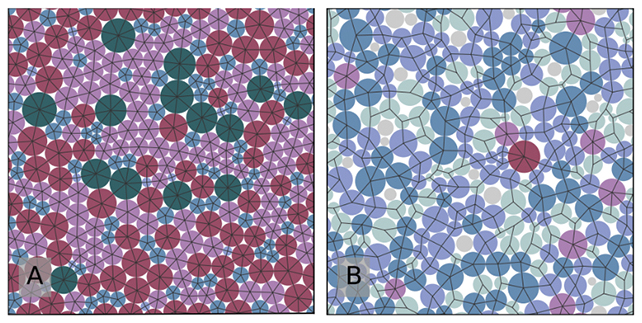
In a recent study led by physicist Viola Bolton-Lum from the University of Oregon, researchers used computer models to demonstrate that ideal glass is possible in two dimensions (2D). This type of glass would have an amorphous arrangement of particles that is also highly ordered and uniform, giving it properties similar to a perfect crystal.
The research team found that traditional cooling methods wouldn't work for achieving this ideal state, as it would require an infinite amount of time. To overcome this challenge, they introduced a method that allows the glass particles to be resized during packing, providing the necessary flexibility.
Properties of Ideal Glass
This innovative approach results in a glass that appears amorphous but exhibits crystalline properties. Specifically, the resulting glass is much more solid and stable than regular glass, with each particle having an average of six points of contact with neighboring particles for added support.
According to physicist Eric Corwin, one of the researchers involved in the study, "We think that we've hit upon a resolution, by showing that such a state is not a paradox at all." He emphasized that the team was able to construct this ideal state, which challenges previous assumptions about the nature of glass.
One of the key differences between ideal glass and regular glass is how it reacts when struck. Instead of causing haphazard vibrations, ideal glass would vibrate with perfect uniformity, similar to the way a diamond behaves.
Additionally, ideal glass would exhibit hyperuniformity. When viewed up close, there would be no clumping or gaps between particles, with each particle occupying just the right amount of space.

Theoretical Nature of the Research
It's important to note that this research is theoretical, as no one has yet manufactured ideal glass in a laboratory setting. The researchers acknowledge that standard heating and cooling processes won't be sufficient to create this glass. New approaches will need to be developed before it can be produced.
Despite this, the study shows that ideal glass is not an impossibility. Given its unique properties, it could potentially be suitable for various applications. However, the specific uses of this material are still unclear, as it is early days for imagining its potential.
Future Implications and Research
There is a lot of room for further investigation into ideal glass and its development, particularly regarding how the method used in the simulations can be replicated in actual physical manufacturing processes. With advances in materials science, there is hope that ideal glass might one day exist in reality.
The researchers emphasize that novel approaches will be necessary to create such packings in practice, as they are not accessible through common thermal or mechanical processes. They suggest that a physical implementation of their algorithm would need to be developed.
The findings of this study were published in Physical Review Letters, marking a significant step forward in the understanding of ideal glass and its potential applications.
Conclusion
The creation of ideal glass represents a major breakthrough in materials science. By demonstrating that this unique state of matter is possible, researchers have opened the door to new possibilities in the field. While the practical realization of ideal glass remains a challenge, the theoretical foundation laid by this study provides a valuable framework for future research and innovation.
Posting Komentar untuk "Glass that Acts Like a Crystal May Be Possible After All"
Please Leave a wise comment, Thank you