
Disney's Robotic Olaf in Paris' Frozen Land
A New Era of Theme Park Robotics
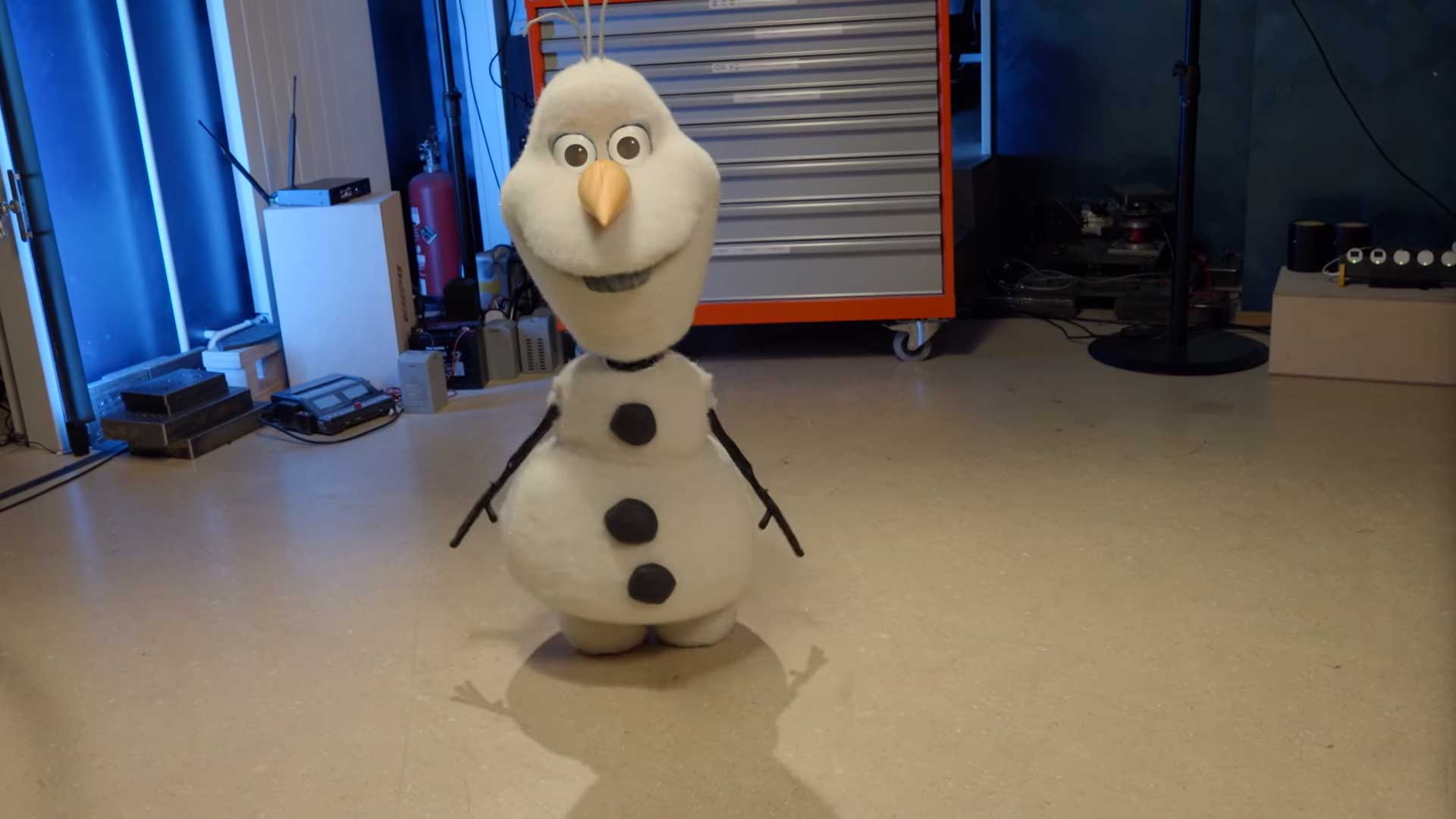
Walt Disney Imagineering Research and Development has unveiled a groundbreaking creation: a free-walking robotic Olaf that will greet visitors when World of Frozen opens on March 29, 2026, inside Disneyland Paris’s second park, now called Disney Adventure World. This robot, first showcased to the public on November 24, 2025, marks a significant advancement in Disney's theme park character program. It is a snowman that walks on its own, talks, and moves its face and limbs with enough realism to pass for the animated original. The innovation stems from a unique blend of hidden mechanical legs, soft-body disguise work, and reinforcement learning trained directly on Frozen animation clips.
Hidden Legs and a Foam Skirt Trick
The primary engineering challenge was translating Olaf's animated form into a physical robot capable of walking across uneven surfaces. The team had to hide asymmetric legs beneath a soft foam skirt, creating the illusion that Olaf’s feet are sliding along his body rather than stepping on the ground. This approach is detailed in a technical paper available on arXiv, which outlines both the mechanical design and control system.
The asymmetric leg design deviates from standard bipedal robotics, as most robots aim for symmetry to simplify balance calculations. However, Disney's engineers embraced asymmetry because Olaf's animated gait is lopsided and bouncy. The foam skirt not only hides the mechanical reality but also preserves the cartoon silhouette that audiences expect. Custom linkages separately drive the robot’s arms, mouth, and eyes, giving operators or onboard software fine control over facial expressions and gestures during live interactions.
To maintain the illusion, the team also addressed weight distribution and center of mass. Olaf’s rounded body offers few flat surfaces, and the character’s head is proportionally large, making it prone to wobbling. By tucking batteries and computing hardware low in the body and using compliant materials in the outer shell, the designers balanced stability with the soft, snow-like appearance. The foam skirt must flex naturally while never revealing the mechanical legs underneath, influencing fabric choice and the geometry of the leg swing.
Reinforcement Learning Trained on Animation
Unlike traditional theme park animatronics that follow pre-scripted motion paths, the Olaf robot uses reinforcement learning guided by animation references from the Frozen films. This means the control system wasn’t hand-coded with fixed movements. Instead, engineers fed clips of Olaf’s screen performances into a learning pipeline, allowing the algorithm to develop motor policies that reproduce those movements on physical hardware. The result is a robot whose walk cycle and body language carry the same timing and personality as the animated character.
This approach has practical benefits beyond aesthetics. Reinforcement learning systems can adapt to changing conditions, such as uneven floors or sudden stops. However, whether Disney’s implementation handles all edge cases reliably in a crowded theme park environment remains an open question. The arXiv paper describes the control framework but does not publish error rates or failure-mode data, a gap that independent researchers will likely explore once the robot is in daily operation.
The learning-based controller also allows for richer behavior over time. In theory, Olaf could be updated with new motion policies reflecting seasonal shows, new film appearances, or safety refinements drawn from operational data. This would mark a shift from the fixed lifespans of classic figures toward characters that evolve, similar to how software products receive over-the-air updates. For now, Disney has not detailed how frequently it plans to revise Olaf’s behavior once the character is in front of guests.
Where Olaf Fits in Disney’s Paris Expansion
The robotic Olaf is part of a multi-year expansion at Disneyland Paris, which has already included laser-enhanced nighttime shows. The resort’s second park has been rebranded as Disney Adventure World, and World of Frozen is the centerpiece of that overhaul, scheduled to open alongside new attractions on March 29, 2026.
This investment signals that Disney sees its European park as a testing ground for technology that could roll out to Orlando, Anaheim, and Asian resorts. A self-walking character robot is more versatile than a fixed animatronic. If Olaf can roam a themed land and interact with guests in real time, the same platform could eventually carry other characters with different body shapes and movement styles. The Disney Parks blog frames the self-walking Olaf as part of a broader robotics platform that includes BDX Droids and other R&D projects, suggesting the underlying locomotion and AI systems are designed to be reused, not built as one-offs.
From an operations standpoint, free-roaming robots raise new questions about crowd management, accessibility, and downtime. Unlike a ride system that can be temporarily closed, a character that walks through pathways must be integrated into traffic patterns and emergency procedures. Disney has not publicly outlined how often Olaf will appear, whether the character will follow fixed routes, or how close guests will be allowed to approach. These details will determine whether Olaf feels like a rare, special encounter or a regular part of the land’s kinetic energy.
What the Imagineering Series Reveals
Disney has been unusually open about the Olaf project’s development process. The company’s documentary series We Call It Imagineering, available on Disney+, dedicates its robotics episode to the self-walking Olaf alongside other R&D work. This level of transparency is atypical for a company that historically guards its illusion-making secrets. The decision to show the robot’s inner workings on a streaming platform suggests Disney believes the engineering story itself has marketing value, turning a technical achievement into content that builds anticipation for the park opening.
The series also provides context that the arXiv paper does not. While the academic publication focuses on algorithms and mechanical specs, the documentary footage shows the iterative process of getting the character’s personality right: how the robot’s eye movements, arm timing, and walking rhythm were tuned until they matched the emotional beats that audiences associate with Olaf. Walt Disney Imagineering leadership presented the robot during its November 2025 showing, and the project was carried out by the R&D division in collaboration with other teams whose specific roles have not been publicly detailed.
For fans who want to follow these developments closely, mobile access has become another part of the strategy. News outlets covering Disney’s European expansion encourage readers to use dedicated apps, such as the Android app on Google Play and the corresponding iOS version, to receive updates on park construction, entertainment offerings, and technology previews. That constant trickle of information keeps the Olaf project in public view well before guests meet the character in person.
The Real Test Starts in the Park
The real proving ground for Olaf will not be lab demos or documentary episodes but daily operation inside World of Frozen. Theme park environments are unpredictable: children may hug the character without warning, strollers and wheelchairs can block paths, and weather can shift from rain to bright sun in a single afternoon. A robot that performs flawlessly on a flat test stage may behave differently when confronted with slick pavement or a dense crowd.
Disney will also have to balance realism with safety and approachability. Olaf is designed to be small and friendly, but the machinery inside is complex and powerful enough to keep the character upright and moving. That implies layers of sensing and fail-safes to prevent collisions or pinched fingers, as well as clear training for human handlers who will escort the robot during its first months in the park. How visible those handlers are, and how much they intervene, will shape whether guests perceive Olaf as an autonomous friend or a high-tech puppet.
If the deployment succeeds, Olaf could mark a turning point in how Disney and its competitors think about characters. Instead of static meet-and-greet spots and parade floats, future lands might rely on fleets of mobile figures that wander, converse, and react in ways that feel closer to film performances. For now, Olaf is just one snowman in one corner of Disneyland Paris. But the technologies under his foam skirt—hidden legs, soft robotics, and animation-trained AI—point toward a future where the line between screen and street grows a little thinner with every park visit.
Posting Komentar untuk "Disney's Robotic Olaf in Paris' Frozen Land"
Please Leave a wise comment, Thank you